Solar mounting hardware often looks simple, but its service life depends on chemistry, design, and installation quality. The question “Why do some solar brackets rust faster than others?” deserves more than a quick answer about cheap steel. Salt spray, trapped water, scratched coatings, poor drainage, and contact between dissimilar metals can accelerate corrosion within months. Small mistakes matter.
Corrosion expert Dr. Gerald S. Frankel offers a useful warning: “Corrosion is controlled by the environment, the material, and the design.” That principle guides this 2026 review of solar bracket types. We compare galvanized steel, anodized aluminum, stainless steel, and coated mounting systems. Each option has strengths. Each also has limits. Stainless steel may resist coastal moisture well, while aluminum can suffer from galvanic reactions when installed beside incompatible metals. Galvanized steel may perform reliably, but damaged zinc protection creates vulnerable points.
This guide focuses on visible, practical details. Look for white corrosion stains, reddish edges, swollen coatings, and water collecting beneath washers. Check whether installers cut or drill brackets without sealing exposed metal. Examine fasteners, because they often fail before the main rail. Still, product labels cannot predict every site perfectly. Soil moisture, industrial pollution, cleaning chemicals, and neglected inspections change the outcome. That uncertainty deserves honest attention.
The best bracket is not always the most expensive one. It is the bracket whose material, coating, fasteners, and drainage suit the local environment. This article explains those differences clearly, helping installers and system owners choose stronger, longer-lasting support for modern solar arrays.
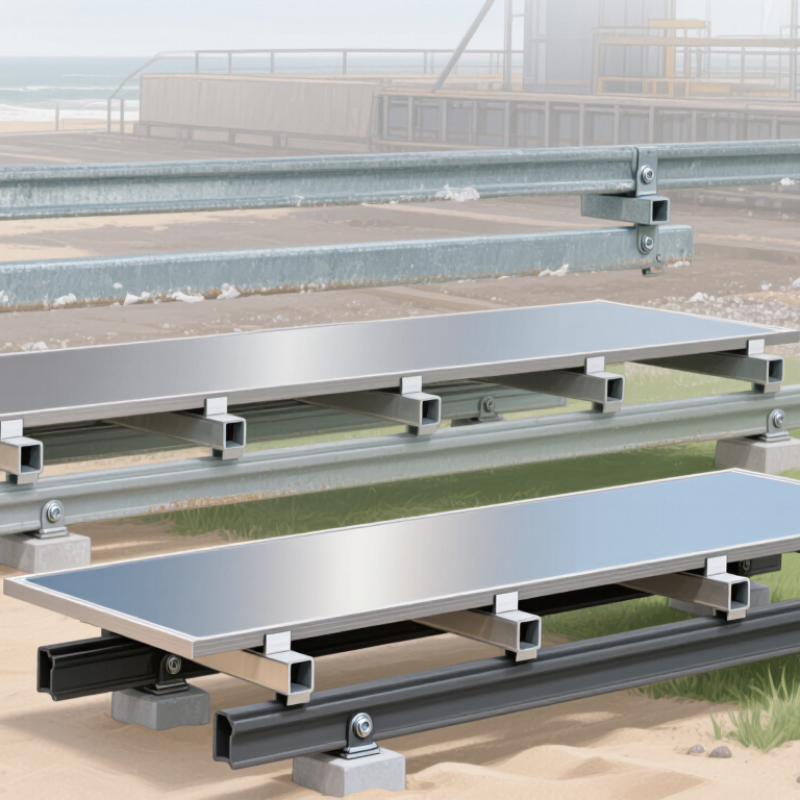
2026 Best Solar Bracket Types: Why Do Some Rust Faster?
Solar bracket systems in 2026 include rooftop rail, rail-less, fixed-tilt ground, single-axis tracker, and floating designs. IEA PVPS Trends 2024 reports more than 1.6 terawatts of global photovoltaic capacity by the end of 2023. This rapid expansion makes mounting durability increasingly important. Rooftop rails usually use anodized aluminum, while ground systems often combine galvanized steel posts with stainless fasteners. Trackers add moving joints, bearings, and more exposed hardware.
Material choice matters, but location matters more. Coastal salt, trapped rainwater, and bird droppings can attack small crevices around clamps. Dissimilar metals may also create galvanic corrosion. A stainless bolt touching bare aluminum is not automatically safe. Isolation washers and correct drainage remain essential. ISO 9223 classifies coastal and industrial atmospheres as higher-corrosion environments, requiring stronger protection and inspection planning. The U.S. National Renewable Energy Laboratory also identifies corrosion, moisture, and fastener failure as recurring photovoltaic balance-of-system risks.
Field inspections often reveal the same pattern: rust begins beneath washers, not across open steel. Small defects grow quietly. Hot-dip galvanizing can outperform thin coatings on exposed ground structures, yet damaged cuts still need attention. Rail-less systems reduce parts, but installation errors can concentrate water under clamps. That is easy to overlook. I would not choose a bracket type from price alone. The better decision combines salt exposure, drainage, metal compatibility, wind loading, and a realistic maintenance schedule. Even then, no design is perfect.
| Bracket Type | Common Material | Typical Corrosion Resistance | Best-Fit Environment | Typical Planning Life | Why It May Rust Faster | 2026 Selection Guidance |
|---|---|---|---|---|---|---|
| Aluminum Rail Bracket | Extruded aluminum, commonly 6000-series alloys | Very good atmospheric corrosion resistance; develops a protective oxide film | Residential and commercial roofs; moderate coastal exposure when correctly specified | Approximately 20–30+ years, depending on design and exposure | Salt deposits, trapped moisture, contact with incompatible metals, and damaged surfaces | A strong general-purpose choice; use compatible stainless fasteners and isolate dissimilar metals where necessary |
| Stainless Steel Roof Hook | Austenitic stainless steel, commonly 304 or 316 grades | Excellent; 316 generally performs better than 304 in chloride-rich coastal conditions | Tile, slate, and metal roofs; coastal and high-humidity locations | Approximately 25–40+ years with suitable grade and detailing | Using 304 in severe marine exposure, surface contamination with carbon steel, or crevices that retain saltwater | Prefer 316 for frequent salt spray; inspect welds, cut edges, and concealed water-trapping areas |
| Hot-Dip Galvanized Steel Bracket | Carbon steel protected by a zinc coating | Good to very good when the zinc layer remains intact; performance varies with coating thickness and environment | Ground mounts, utility structures, and inland or rural installations | Approximately 15–30 years; longer in low-corrosion environments | Cut edges, drilled holes, scratches, standing water, acidic pollution, and high chloride exposure | Specify coating thickness for the exposure category and repair damaged areas with an appropriate zinc-rich system |
| Pre-Galvanized Steel Bracket | Steel sheet coated with zinc before forming | Moderate; exposed formed edges and holes may have less protection than the original sheet surface | Dry inland locations with limited weather exposure | Approximately 8–20 years, depending on coating mass and exposure | Forming damage, cut edges, drilled holes, condensation, and water trapped between overlapping parts | Use cautiously outdoors; hot-dip galvanized or stainless alternatives are generally more durable in wet or coastal areas |
| Powder-Coated Steel Bracket | Steel with a polymer powder coating, often over a zinc-treated surface | Good while the coating is continuous; exposed steel can corrode rapidly after coating failure | Architectural applications and moderate inland climates | Approximately 10–25 years, depending on coating system and UV exposure | Impact damage, UV degradation, poor pretreatment, edge creep, and moisture beneath the coating | Check coating pretreatment and outdoor ratings; avoid relying on cosmetic coating alone for severe marine exposure |
| Stainless Steel Standing-Seam Clamp | Stainless steel clamp body with stainless or compatible fasteners | Excellent when the clamp is compatible with the roof metal and correctly torqued | Metal roofs, including many exposed and coastal applications | Approximately 25–40+ years | Galvanic coupling with incompatible roof metals, crevice corrosion, salt accumulation, and over-tightening | Match clamp material to the roof system and avoid mixing stainless, aluminum, copper, and zinc without proper isolation |
| Aluminum Tile-Roof Hook | Corrosion-resistant aluminum alloy | Very good in normal atmosphere; not immune to galvanic attack | Tile roofs in inland and moderately humid regions | Approximately 20–30+ years | Direct contact with copper or certain steel components, alkaline deposits, and crevice moisture | Use compatible washers and fasteners; provide drainage and prevent metal-to-metal contact where galvanic corrosion is possible |
| Ground-Mount Steel Post Bracket | Hot-dip galvanized or protective-coated structural steel | Good to excellent when coating, drainage, soil contact, and structural detailing are properly designed | Open-field, agricultural, and utility-scale solar installations | Approximately 20–40+ years; soil conditions can reduce durability | Soil-side corrosion, fertilizer or animal-waste exposure, poor drainage, coating damage, and dissimilar-metal connections | Assess soil corrosivity and water drainage; protect interfaces and inspect below-grade or splash-zone areas |
Material, coating damage, trapped water, and local climate all influence corrosion. Rust can begin around a scratched edge or bolt thread. Appearance alone can mislead.
Anodized aluminum is lightweight and resists moisture, but scratches and cut edges need attention. Galvanized steel is strong, although exposed edges may corrode earlier. Stainless steel generally suits salty coastal air, but costs more.
Tight joints and blocked drainage holes trap water. The joint becomes a small corrosion chamber. Open drainage paths help surfaces dry after rain.
Yes. Different metals can cause galvanic corrosion when moisture connects them. A stainless bolt touching untreated aluminum may leave white oxidation nearby. Isolation washers can reduce this risk.
Over-tightened bolts can damage protective coatings. Drill holes, metal filings, concrete dust, and poor spacing may retain moisture. Brackets should never sit in standing water.
No. A thick coating can fail after careless installation scratches it. Coating quality, edge protection, drainage, and handling matter together. This is easy to underestimate.
Look for orange stains, white deposits, loose bolts, swollen sealants, and damaged edges. Inspect beneath rails and around shaded fasteners. Hidden surfaces can corrode first.
Inspect them at least yearly, especially in humid or coastal locations. Salt deposits and trapped moisture may require more frequent checks. A clean-looking rail is not proof of safety.
This guide explores the main solar bracket types used in 2026, including rail-based, rail-less, adjustable, roof-mounted, and ground-mounted systems. It explains how bracket performance depends on material selection, surface treatment, structural design, drainage, and compatibility with different roof or ground conditions. Aluminum, stainless steel, coated steel, and other metal options each provide different levels of strength, weight control, corrosion resistance, and maintenance requirements.
Why do some solar brackets rust faster than others? The answer often involves a combination of material quality, damaged protective coatings, trapped moisture, salt in coastal air, industrial pollution, temperature changes, and poor installation practices. Incorrect fasteners, water-collecting joints, scratches, and direct contact between incompatible metals can also accelerate corrosion. The article offers practical guidance for choosing durable brackets, checking drainage and connections, protecting exposed surfaces, and performing regular inspections so that solar mounting systems remain secure, reliable, and long-lasting.

 Soltrux Solar