China Top 10 Solar Brackets for Snow and Heavy Rain?

Time:2026-10-13 Author:Liam
0%

Solar power is expanding rapidly, but harsh weather still tests every mounting decision. The IEA Renewables 2024 report recorded about 510 GW of new renewable capacity worldwide in 2023, with solar photovoltaic systems providing roughly three-quarters of that growth. More installations now face mountain snow, typhoon rain, coastal salt, and repeated freeze-thaw cycles.

Can solar brackets withstand snow and heavy rain? Yes, when engineers match the structure to local loads, roof conditions, and installation quality. A bracket is not strong merely because its aluminum looks thick. Rail spacing, fastener pull-out strength, waterproof flashing, drainage paths, and corrosion protection all matter. On a snowy roof, drifting can place uneven pressure beside the array. During heavy rain, a poorly sealed penetration may cause damage long before the bracket bends.

This article reviews China’s top ten solar brackets for snow and heavy rain. It considers material grades, load-test evidence, wind and snow design references, drainage details, adjustability, and field practicality. The evaluation follows principles used in ASCE 7-22, relevant Chinese structural standards, and IEC photovoltaic reliability guidance. Manufacturer claims are useful, but independent testing and project records deserve more weight. Small details matter.

No ranking is flawless. Some suppliers publish limited test data, while field performance can vary with workmanship and climate. Therefore, readers should verify regional snow loads, wind speeds, roof type, fastener compatibility, and warranty terms before purchasing. A bracket that survives a laboratory test may still fail when installers overtighten clamps, block drainage, or ignore hidden roof corrosion. Reliable design begins with evidence, not attractive product photos.
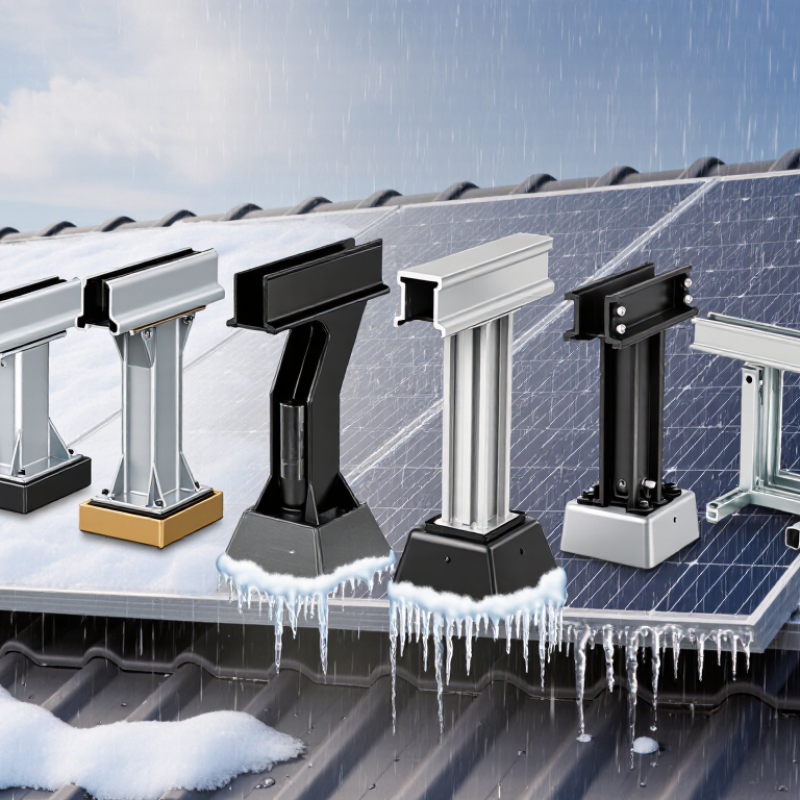
China Top 10 Solar Brackets for Snow and Heavy Rain?

What Makes Solar Brackets Suitable for Snow and Heavy Rain

Solar brackets for snow and heavy rain need more than a strong appearance. Their suitability depends on load calculations, drainage design, corrosion resistance, and secure roof connections. Engineers should assess local snow depth, wind exposure, panel angle, and the roof’s structural condition before selecting a system. A bracket designed for mild weather may deform when wet snow gathers between panels.

Rigid aluminum or hot-dip galvanized steel can resist outdoor corrosion when properly treated. Stainless steel fasteners also reduce rust around joints. However, material alone is not enough. Details matter. The bracket should spread pressure across the roof structure, while clamps must hold panels without crushing their frames. Sloped layouts help snow slide away and prevent standing water after intense rainfall. Roof penetrations need reliable flashing and sealing, especially around screws and mounting rails.

Field inspection records often show that water enters through small installation errors, not dramatic structural failures. Uneven rails, loose bolts, blocked drainage paths, and mixed metals can create trouble months later. That is easy to overlook. Brackets should allow thermal movement, because repeated heating and cooling can loosen connections. Regular checks should examine rust, cracked seals, displaced clamps, and snow marks on the roof. Even a carefully engineered design may need adjustment when actual snowfall, roof aging, or drainage conditions differ from the original assumptions.

Key Materials and Structural Designs Used in Chinese Solar Brackets

China Top 10 Solar Brackets for Snow and Heavy Rain?

Among China’s top ten solar bracket configurations, material selection often separates durable systems from fragile installations. Hot-dip galvanized steel offers strong load resistance and practical cost control. Aluminum reduces weight, but it needs careful alloy and fastener matching. Stainless steel performs better around coastal moisture, although its price can rise sharply.

Snow changes everything. Sloped rails help snow slide away, while triangular supports reduce bending across long spans. Reinforced purlins distribute pressure across several roof points. For heavy rain, raised mounting feet protect drainage paths and reduce standing water beneath modules. Sealed bolt holes also limit water entry. Small details matter.

The IEA PVPS Trends 2024 report recorded more than 400 GW of new photovoltaic capacity worldwide in 2023. This rapid expansion increases demand for reliable structural engineering. The IPCC Sixth Assessment Report states that extreme precipitation generally intensifies by about 7% for each 1°C of warming. Local calculations should therefore follow Chinese load standards, including GB 50009, rather than rely on generic product tables. Engineers should check snow drift, wind uplift, roof age, and corrosion exposure together. A bracket can survive the calculated load yet fail at a weak connection. That assumption is risky. Field inspections sometimes reveal uneven welding, undersized washers, or drainage blocked by rails. Generic designs are convenient, but they are not always honest.

China Top 10 Solar Brackets for Snow and Heavy Rain

Representative material grades and structural configurations commonly considered for solar mounting systems exposed to snow, strong wind, and heavy rain. The chart compares representative minimum yield strength values; corrosion protection, drainage, fastener design, and site-specific structural calculations are also essential.

Hot-dip galvanized Q235B and Q355B steel are widely used for high-load rails, adjustable brackets, and tripod structures. Aluminum alloys reduce weight, while 304 and 316 stainless steel are often selected for clamps and highly corrosive or coastal environments. Yield strength is a material reference rather than a product load rating; final bracket selection must follow local snow-load, wind-load, drainage, and foundation requirements.

Top 10 Chinese Solar Bracket Options for Severe Weather Conditions

China’s severe-weather bracket market offers more than low-cost metal frames. The IEA PVPS Trends 2024 report recorded global solar capacity above 1.6 terawatts by the end of 2023. China added 216.88 gigawatts that year, according to its National Energy Administration. That scale makes structural reliability increasingly important. Snow, pooled rainwater, freeze-thaw cycles, and gusts can expose weak connections quickly.

Ten practical Chinese bracket options deserve attention: hot-dip galvanized steel fixed frames, anodized aluminum rails, stainless-steel clamps, low-profile roof hooks, adjustable-tilt frames, ballasted rooftop systems, ground-screw foundations, driven-pile structures, concrete-base systems, and waterproof integrated rails. Galvanized steel suits heavy snow and larger spans. Aluminum reduces roof weight, but needs careful corrosion separation. Stainless clamps resist moisture around module edges. Adjustable systems help clear snow, although moving parts need inspection. Ballasted designs avoid roof penetration, yet ballast increases dead load during rain. Ground screws and piles perform well on open sites when soil testing is available.

IEC 61215 qualification commonly uses 2,400 Pa mechanical-load testing, but that does not approve an entire mounting system. Engineers should calculate site snow and wind loads under applicable national standards. Drainage paths need visible clearance. Fasteners should remain accessible after installation. I would not trust a catalog load claim alone. In practice, corrosion protection, bolt torque, roof condition, and local workmanship often decide performance. A stronger frame can still fail at a poorly sealed penetration.

China Top 10 Solar Brackets for Snow and Heavy Rain? - Top 10 Chinese Solar Bracket Options for Severe Weather Conditions

No. Solar Bracket Option Typical Application Primary Material Corrosion Protection Typical Tilt Indicative Snow Design Range* Indicative Wind Design Range* Severe-Weather Features
1 Aluminum Rail Pitched-Roof System Tile, slate, and composite pitched roofs 6063-T5 or 6005A-T6 aluminum rails; stainless steel fasteners Natural aluminum oxide layer; optional anodizing 15°–45° 1.0–2.5 kPa 30–45 m/s Multiple roof anchors, low-profile rail connections, and adjustable end clamps help distribute snow and wind loads.
2 Standing-Seam Metal Roof Clamp System Standing-seam steel or aluminum roofs without roof penetration Aluminum clamps, aluminum rails, stainless steel bolts Anodized aluminum and stainless steel hardware 5°–30° 1.0–2.0 kPa 30–40 m/s Non-penetrating clamps preserve roof waterproofing; seam strength and clamp spacing must be verified for each roof profile.
3 Trapezoidal Metal-Roof Mini-Rail System Industrial buildings with trapezoidal or corrugated sheet roofing Aluminum mini-rails; galvanized or stainless steel self-drilling fasteners Anodized aluminum; EPDM sealing washers 5°–25° 0.8–1.8 kPa 28–40 m/s Short rail spans reduce material use while sealing washers and correctly positioned fasteners help control rainwater leakage.
4 Heavy-Duty Tile-Roof Hook System Clay, concrete, and interlocking tile roofs in snowy regions 304 stainless steel hooks; aluminum rails Stainless steel with aluminum rail protection 20°–50° 1.5–3.0 kPa 35–50 m/s Reinforced hooks, wider base plates, and increased attachment density are suitable for higher snow accumulation and uplift forces.
5 Low-Tilt Ballasted Flat-Roof System Concrete roofs where penetrations are restricted Aluminum or galvanized steel frames; concrete ballast blocks Anodized aluminum; hot-dip galvanized steel 5°–15° 0.6–1.5 kPa 25–35 m/s Low tilt lowers wind exposure; ballast layout, roof friction, drainage paths, and roof load capacity require site-specific checks.
6 Anchored Flat-Roof Tilted System Concrete or steel flat roofs requiring stronger wind resistance Hot-dip galvanized structural steel or aluminum Zinc coating according to project specification; stainless fasteners 10°–30° 1.5–3.0 kPa 35–50 m/s Mechanical anchors provide reliable uplift resistance; waterproofing details around penetrations are essential during installation.
7 Fixed-Angle Galvanized Steel Ground Mount Utility, commercial, and agricultural ground-mounted arrays Structural steel posts, beams, purlins, and aluminum module clamps Hot-dip galvanizing; stainless steel module fasteners 15°–40° 1.5–4.0 kPa 35–55 m/s Deep foundations, braced frames, and adjustable pile spacing allow design adaptation for heavy snow and strong wind zones.
8 Ground-Screw Solar Mounting System Soil sites where concrete foundations are difficult or undesirable Hot-dip galvanized steel ground screws and support frames Hot-dip galvanizing; optional higher-grade steel for aggressive soil 15°–40° 1.0–3.0 kPa 30–50 m/s Fast installation and adjustable foundations are useful for uneven sites; pull-out testing and soil investigation are required.
9 Solar Carport Structural System Parking areas requiring solar generation and vehicle shelter Hot-dip galvanized steel columns and beams; aluminum module rails Hot-dip galvanizing with sealed drainage components 5°–15° 1.0–2.5 kPa 35–50 m/s Rigid portal frames, engineered foundations, rain gutters, and concealed cable routing improve performance in heavy rain and wind.
10 Stainless-Steel Coastal and High-Humidity System Coastal, humid, industrial, or salt-laden environments 6063-T5 aluminum rails; 304 or 316 stainless steel hooks and fasteners Anodized aluminum with stainless steel hardware selected for exposure conditions 10°–45° 1.0–3.0 kPa 35–55 m/s Reduced galvanic corrosion risk, sealed interfaces, and corrosion-resistant fasteners support long-term operation in wet and saline conditions.
*Engineering note: The snow and wind figures are indicative screening ranges for comparing mounting-system configurations, not guaranteed product capacities. Final values must be calculated for the specific site using local terrain, roof or soil conditions, module dimensions, mounting span, foundation design, exposure category, and applicable standards such as GB 50009 and GB 50017. Heavy-rain performance also depends on roof waterproofing, drainage design, sealing details, and installation quality.

How to Compare Load Capacity, Corrosion Resistance, and Durability

A credible China Top 10 Solar Brackets for Snow and Heavy Rain comparison starts with engineering evidence, not catalog photos. In China, GB 50009-2012 requires site-specific snow and wind pressures. Therefore, “heavy duty” proves little without location, tilt, span, and roof type. Compare design load, test load, and safety factors separately. Snow can accumulate beside parapets. Heavy rain also tests drainage and roof sealing.

For corrosion, request alloy grades, coating thickness, salt-spray results, and fastener compatibility. ISO 9223 classifies atmospheric exposure from C1 to CX. Coastal sites may need stronger protection than inland rooftops. Hot-dip galvanized steel, anodized aluminum, and stainless fasteners can perform well. However, mixed metals need isolation washers. IEA PVPS Trends 2024 discusses PV systems commonly operating for 25 to 30 years. NREL’s 2021 review found median module degradation near 0.5% yearly. The support structure should not become the weak link.

Tips: Ask for stamped calculations under GB 50009, material certificates, drainage details, and cyclic-loading evidence. Check bolt torque after installation. Inspect cut edges after the first wet season. A spreadsheet can mislead. Short salt-spray tests cannot reproduce freeze-thaw cycles, ponding water, or construction scratches. Real durability also depends on installation quality, which comparisons often ignore.

Installation and Maintenance Practices for Snowy and Rainy Regions

When comparing China’s top ten solar brackets for snow and heavy rain, installation quality matters as much as bracket strength. A reliable system starts with verified snow, wind, and corrosion ratings. Local structural codes and project calculations should guide the final choice. Do not rely on a product label alone.

On snowy roofs, installers should check rafter positions before drilling. Anchors must enter sound structural material, not weak roofing layers. Keep the planned tilt angle clear of drifting snow. A small gap between panels helps melting water escape. Use stainless or suitably coated fasteners near wet coastal areas. Every bolt needs controlled torque, recorded during inspection. Hand-tightening is not enough.

Rain creates different problems. Installers should preserve drainage paths and avoid blocking roof outlets. Cable loops must face downward, preventing water from entering connectors. After installation, inspect seals, clamps, and exposed metal after the first heavy storm. Look for rust stains, loose rails, cracked sealant, and unusual panel movement. Remove packed snow with approved tools, never sharp metal edges. Access work should use trained personnel and fall protection. I have seen maintenance plans fail because inspections were scheduled only once a year. That is too rigid for mountain regions. Storm damage can appear overnight. No checklist is perfect. Local weather records, roof age, and changing snow patterns should adjust the inspection schedule. A qualified engineer should review unexpected movement or structural cracks before repairs continue.

FAQS

Which materials are commonly used for solar brackets in snowy or rainy regions?

Hot-dip galvanized steel provides strong load resistance and controlled costs. Aluminum reduces weight but requires compatible alloys and fasteners. Stainless steel suits coastal moisture, though its price can rise sharply.

How does snow affect bracket design?

Sloped rails help snow slide away. Triangular supports reduce bending across long spans. Reinforced purlins spread pressure across several roof points.

Can a bracket survive snow loads but still fail?

Yes. Weak connections can fail first. Uneven welding, small washers, or poor anchors may undermine a strong frame. That assumption is risky.

How should engineers calculate loads for a roof installation?

They should follow local structural standards, including GB 50009. Calculations should consider snow drift, wind uplift, roof age, and corrosion exposure together.

How can brackets handle heavy rain more effectively?

Raised mounting feet protect drainage paths and reduce standing water. Sealed bolt holes limit water entry. Rails should never block roof outlets.

What should installers check before drilling into a snowy roof?

They should locate the rafters first. Anchors must enter sound structural material, not weak roofing layers. A small panel gap helps melting water escape.

How should fasteners and bolts be managed?

Use stainless or suitably coated fasteners near wet coastal areas. Apply controlled torque to every bolt and record it. Hand-tightening is not enough.

What maintenance checks are useful after a heavy storm?

Inspect seals, clamps, and exposed metal. Look for rust stains, loose rails, cracked sealant, or unusual panel movement. Storm damage can appear overnight.

How often should solar brackets be inspected?

A fixed yearly schedule may be too rigid for mountain regions. Snow patterns, weather records, and roof age should adjust inspection timing. No checklist is perfect.

What should happen if the structure moves or cracks?

Stop further repairs and request a qualified engineer’s review. Remove packed snow only with approved tools, never sharp metal edges. Access work needs trained personnel and fall protection.

Conclusion

Can solar brackets withstand snow and heavy rain? Yes, when they are designed with sufficient load capacity, durable materials, and reliable drainage performance. This article explores how solar brackets can be adapted to severe weather, focusing on corrosion-resistant aluminum alloys, galvanized or stainless steel components, reinforced rails, secure fasteners, and structural designs that distribute snow loads and resist strong winds. It also introduces ten types of Chinese solar bracket solutions suitable for snowy and rainy regions, covering rooftop, ground-mounted, and adjustable systems without focusing on specific brands.

The guide explains how to compare brackets by snow-load rating, wind resistance, corrosion protection, connection strength, service life, and overall durability. It also highlights practical installation and maintenance measures, such as accurate structural assessment, correct anchoring, suitable tilt angles, regular inspection of drainage paths, and timely removal of excessive snow or accumulated debris. These considerations help users select and maintain a dependable solar mounting structure for challenging climates.

Liam

Liam

Liam is a dedicated marketing professional with a profound expertise in the industry, where he excels at highlighting the unique advantages of our core products. With a keen understanding of market trends and consumer needs, Liam frequently updates our company’s professional blog, providing......